
Free Wildfire Home Self-Inspection
Walk your property with your phone, work through the checklist below, and send us the photos. A real person reviews every submission and sends you back a prioritized, plain-language list of what to fix first — free, with no obligation to hire anyone.
Prefer to work from paper?
Download the 4-page checklist. Print it and carry it round the property on a clipboard, or fill it in on screen — every box and field works either way. It has all four zone checklists, the photo shot list, and a grid for sketching your property.
4 pages · fillable · free
How it works
1
Walk your property
Start at the house and work outward through the three zones below. Budget 30–45 minutes.
2
Take photos
About 15–20 photos. The shot list in each section tells you exactly what to capture.
3
Send it in
Upload your photos and checklist answers using the form at the bottom of this page.
4
Get your review
Within 3 business days you receive a written summary: what needs attention, in what order, and roughly what it costs.
Before you start
What you need: a phone with a camera, comfortable shoes, and about 30–45 minutes. A tape measure helps but is not required — pacing works fine (one adult stride is roughly 3 feet).
Pick a good day. Daylight, no rain, and ideally not full midday sun — harsh shadows hide detail. Overcast is perfect.
Print the PDF above, or open this page on your phone, so you can tick items off as you go. Every checklist item is written so you can answer it by looking, without any special knowledge.
You do not need to complete every item to submit. If you cannot see something, or you are not sure, leave it blank and note it in the form — that is useful information too.
Zone 0 — The Ember-Resistant Zone
The first 5 feet from every exterior wall, deck, and stairway
This is the single highest-value zone on your property. Most homes that burn in a wildfire are not hit by a wall of flame — they are ignited by wind-blown embers landing in this strip and finding something to burn. Insurers and the IBHS Wildfire Prepared Home standard both treat it as the priority.
Checklist
Photos to take in Zone 0
- One straight-on photo of each side of the house — stand back far enough to see roof to ground.
- A close-up of the base of the wall where siding meets the ground, on the two sides with the most landscaping.
- Any deck or porch photographed from the side, low enough to show what is underneath.
- The point where any fence attaches to the house.
- Anything currently stored within 5 feet of the wall.
Zone 1 — Lean, Clean, and Green
5 to 30 feet from the house — or to your property line, whichever is closer
This zone decides whether a ground fire arriving at your property has enough continuous fuel to reach the house and climb. The goal is not a bare moonscape; it is breaking up fuel so fire has to stop and start.
Checklist
Photos to take in Zone 1
- One photo from each corner of the house looking outward — four photos total.
- Any tree whose branches come within 10 feet of the roof or chimney.
- Your firewood stack and its surroundings.
- Each shed or outbuilding, showing the ground around it.
- The propane tank, if you have one.
Zone 2 — The Reduced Fuel Zone
30 to 100 feet from the house — or to your property line, whichever is closer
This zone is about slowing a fire down and dropping flame height before it reaches Zone 1, and about giving firefighters somewhere safe to work. On a slope, fire moves faster uphill, so homes above a grade need wider spacing.
Checklist
Photos to take in Zone 2
- A wide shot looking away from the house in each direction — four photos.
- Any slope above or below the house, photographed from the side so the grade is visible.
- The driveway from the road, and the house number sign.
- Any area of heavy brush, dead trees, or accumulated debris.
The House Itself
Home hardening — the building, not the landscape
Clearing vegetation matters, but the building envelope is what actually stops an ember. These items are more expensive than yard work, which is exactly why it is worth knowing which ones apply to you before you spend anything.
Checklist
Photos to take of the house
- The roof from ground level on each side — get the eave line in frame.
- A close-up of one attic or crawlspace vent, close enough to see the mesh.
- A close-up of the underside of an eave.
- One window, and the siding where it meets the ground.
- The deck from underneath or from the side.
- The garage door closed, photographed low and straight on.
How to take the photos
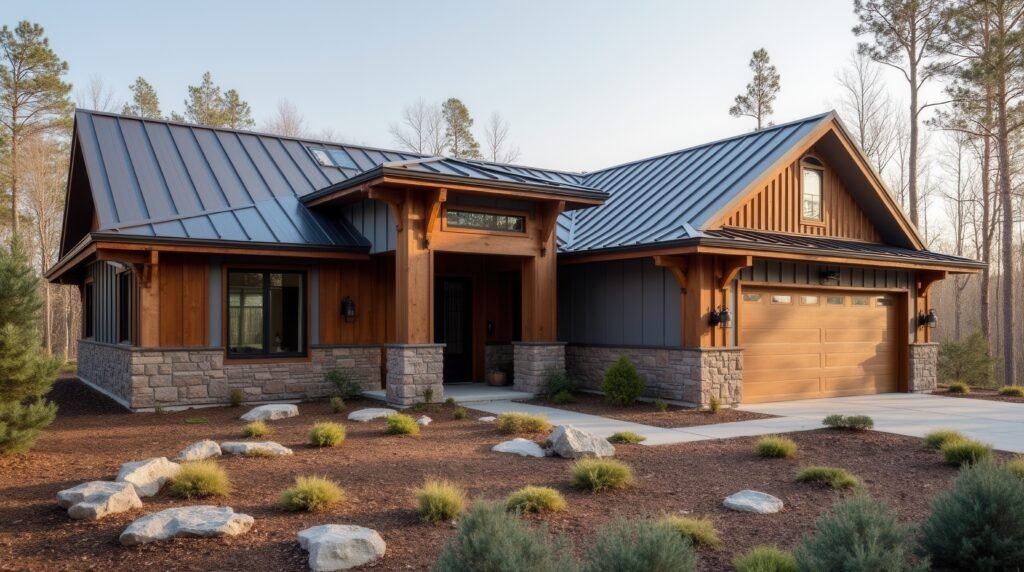
Do this
- Hold the phone horizontally.
- For wide shots, back up until you can see roof to ground in one frame.
- For close-ups, put something in frame for scale — your shoe, a tape measure, a dollar bill.
- Shoot in daylight, overcast if possible.
- Take the photos in the order of the checklists so they arrive grouped by zone.
- 15 to 20 photos is the right amount. More is fine; fewer than 10 makes the review much less useful.
Skip this
- Do not climb on the roof or a ladder. Everything on this list can be photographed from the ground.
- Do not include people, license plates, or your neighbors’ property.
- Do not send video — still photos only.
- Do not worry about photo quality. A normal phone photo is more than enough detail.
- Do not skip a zone because it looks fine. A photo showing something is already compliant is a useful photo — it means we will not tell you to fix it.
What happens next
A real person reviews it
Your photos and answers are read by a person, not scored by software. Submissions are reviewed in the order they arrive.
You get a written summary
Within 3 business days: what needs attention, ranked by how much risk it removes per dollar, in plain language with no jargon.
You decide what to do with it
Do the work yourself, hand the list to a contractor you already use, or ask us to match you with vetted contractors in your state. Nothing is automatic and there is no cost either way.
Much of what shows up in these reviews is work you can do yourself in a weekend — moving a woodpile, pulling mulch back from the foundation, clearing gutters. We will tell you which items those are rather than steering everything toward a contractor.
Submit your self-inspection
Anything you ticked in the checklists above is already carried down into this form — check it over, fill in the rest, and blank answers are fine. Tell us what you were unsure about and we will look for it in your photos.
If you want to go deeper
The checklists on this page are the working version. If you would rather understand the reasoning than follow a list, these are worth your time.
Free, and current
Start here. These are the standards insurers and fire agencies actually reference, and they are kept up to date.
- CAL FIRE — Defensible Space zones. The clearest plain-language definition of Zones 0, 1, and 2, with the specific distances. Written for California, but the zone framework is used across the West.
- IBHS Wildfire Prepared Home. The insurance industry’s own research arm. Its Base and Plus designations are the closest thing to a national home-hardening standard, and its checklist is what an underwriter is most likely to recognize.
- NFPA Firewise USA. The national program, organized around the same home ignition zones, with a neighborhood-level track if you want to bring your street along.
Books worth owning
All three are genuinely good. Read the note underneath before you buy.
Firescaping Your Home: A Manual for Readiness in Wildfire Country
Adrienne Edwards and Rachel Schleiger · Timber Press, 2023 · 264 pages · ISBN 978-1-64326-135-5
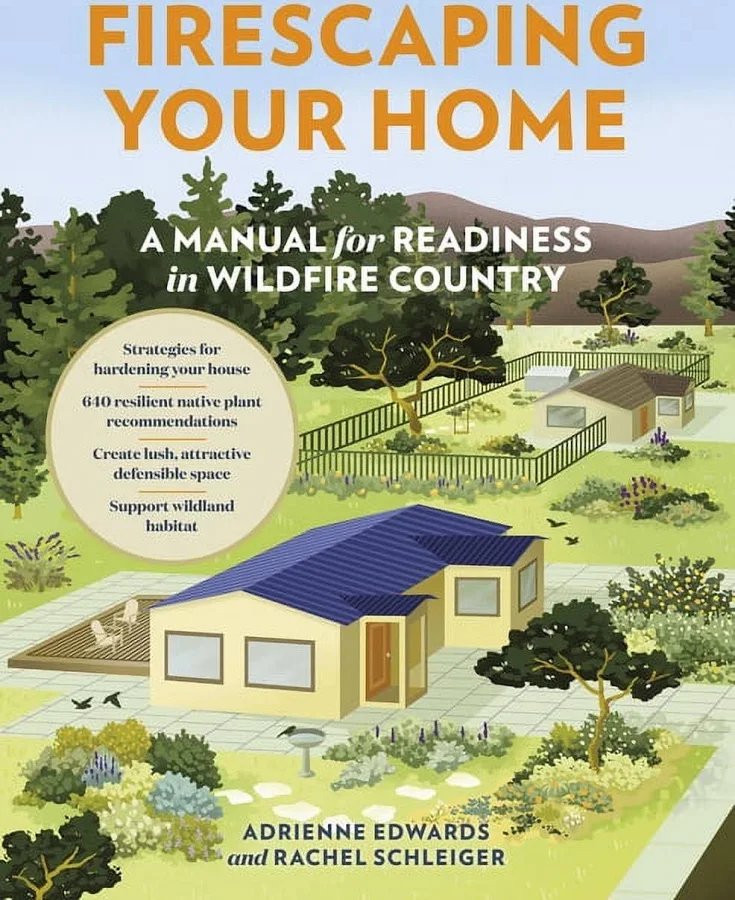
The best of the three if your problem is vegetation, and the most current. Written by two plant ecologists specifically for California, Oregon, and Washington, with a large catalogue of native species that coexist with fire. Strong on how fire behaves and on planning defensible space you would actually want to look at. This is the one to hand a landscaping or forestry contractor.
Fire Smart Home Handbook: Preparing For and Surviving the Threat of Wildfire
Clyde Soles, with a foreword by Molly Mowery · Lyons Press, 2014 · 288 pages · ISBN 978-0-7627-9690-8
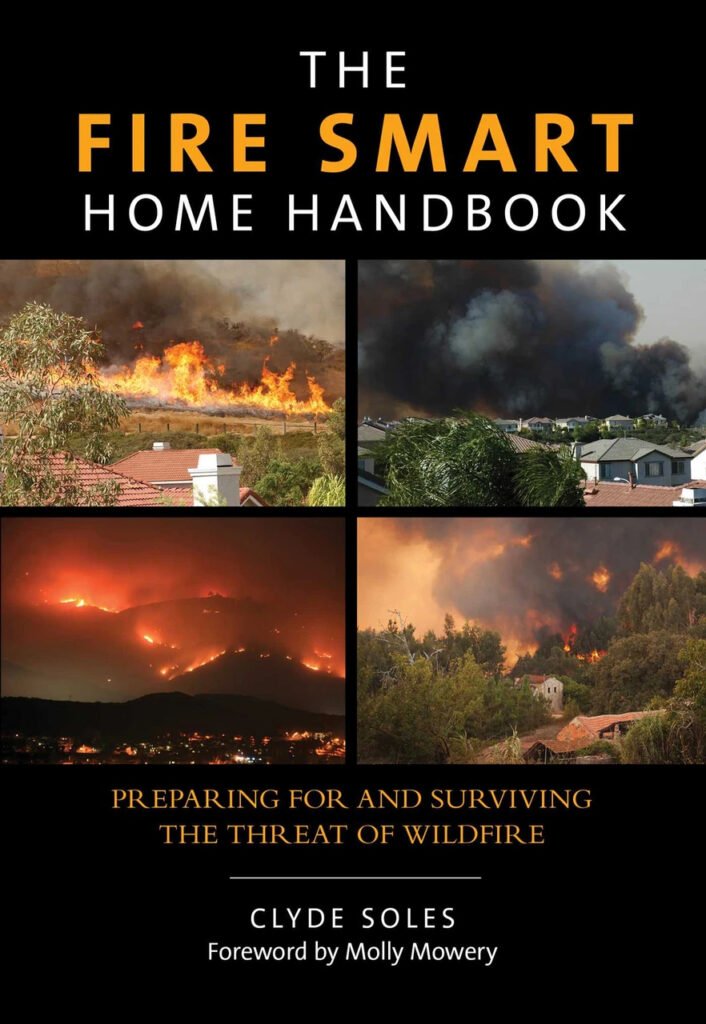
The most thorough of the three on the structure itself — roofing, siding, vents, glazing, decks — and it tiers the work by cost, which makes it easy to sort what you can do from what needs a contractor. Also the best treatment of what to do in the days and hours before a fire arrives.
The Homeowner’s Guide to Wildfire Prevention
Robert Sieben · Bay Tree Publishing, 2014 · 70 pages · ISBN 978-0-9859399-6-0
Short, blunt, and practical — you can read it in an evening. Written by a physician who has served as the volunteer fire prevention coordinator for his Oakland homeowners association since 1998, so it is grounded in what actually gets done on real properties. Good on ember-proofing vents, plant spacing, and gas shut-off valves.
One caveat on the books
Two of the three were published in 2014. That is before Zone 0 existed as a regulatory concept, before IBHS launched Wildfire Prepared Home in 2022, and before California adopted its Zone 0 rule. Their principles hold up well — embers, ladder fuels, vents, and roofing have not changed — but where a book and a current official standard disagree on a specific distance or requirement, follow the standard. The free links above are the authority; the books are for the reasoning behind them.
We are not paid anything if you buy these, and we are not affiliated with any of the publishers or programs listed. Your local fire district or Firewise chapter will often lend copies, and many are in public library systems.
What this review is, and what it is not
This is a remote review of photos and information you provide. It is not a professional inspection. We do not visit your property, and we cannot evaluate anything that is not visible in the photos you send.
This review is not an insurance inspection, a determination of insurability, a code compliance ruling, a defensible space inspection under the law of any state, an IBHS Wildfire Prepared Home evaluation, or a substitute for an assessment by a certified wildfire mitigation specialist or your local fire district. Insurance carriers and fire agencies make their own determinations and are not bound by anything we tell you.
Completing the items on this page does not guarantee that your home will survive a wildfire, that your policy will be renewed, or that you will qualify for any discount or program.
MitigateMyHouse is a referral service. If you ask to be matched with a contractor, we are paid a referral fee by that contractor. The self-inspection review itself is free and carries no obligation. We do not sell your information to third parties — see our Privacy Policy.
Do not put yourself at risk gathering photos. Everything on the checklists can be photographed safely from the ground. Do not climb on your roof or use a ladder for this.